In the very heart of Willemstad, on the Punda side, right next to the iconic Queen Emma Bridge, there once stood three simple but powerful symbols: three hearts where people could seal their love with a lock. It was a small idea with enormous emotional value. Tourists came for it. Locals embraced it. Curaçao promoted it to the world as a place where love could quite literally be locked in.
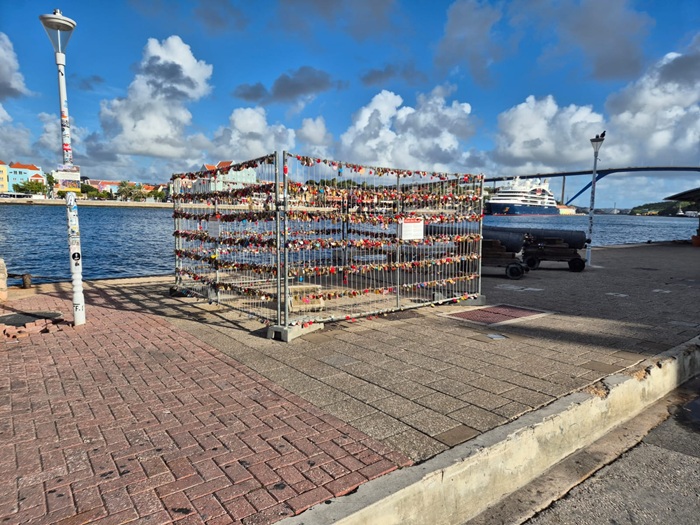
Photo credit: Farley Browne
At one unforgettable moment, even King Willem-Alexander and Queen Máxima added their own lock there, in front of hundreds of spectators. A beautiful, symbolic act that placed Curaçao on the global map in a way no marketing slogan ever could.
And then, months ago, the hearts collapsed.
Not because of vandalism. Not because of neglect. But because of weight — the very thing everyone knew would happen from the start. Other cities had already learned that lesson. In Paris, when love locks began to threaten historic bridges, the authorities intervened immediately. Locks were removed. Structures were reinforced. Measures were taken before disaster struck.
Back in Curaçao, the hearts fell. And what followed?
Promises.
The public was told the hearts would return. New ones. Stronger ones. Better designed. A renewed symbol of love in the heart of our capital. That promise was made many months ago. Since then, nothing meaningful has happened — except for one thing: a metal cage was placed where the hearts once stood.
And now comes the painful irony.
The promise of “locking your love in Curaçao” continues to be promoted. Visitors still come. Couples still want to participate. And what do they do? They attach their locks to the cage. A cage that is already filling up. A cage that will, inevitably, also collapse under the same weight.
Are we really going to let this happen again?
Are we truly unable — or unwilling — to fix something so visible, so symbolic, so easy to understand? This is not a complex infrastructure project. This is not a billion-guilder reform. This is about three hearts in the most photographed spot in the country.
So the questions must be asked, loudly and clearly.
Where is the Ministry of Public Works?
Where is the Downtown Management Organization?
Who is responsible for making sure that promises made to the public — and to the world — are actually kept?
This is not just about aesthetics. It is about credibility. About care for public space. About whether Curaçao takes its own symbols seriously. When something breaks in the middle of our capital and remains broken for months, it sends a message — and it is not a flattering one.
Fixing the hearts would not just restore a tourist attraction. It would restore trust. It would show that Curaçao can learn, act, and deliver. That when something clearly matters to people, the government and its agencies are capable of moving faster than the rust on a metal cage.
So again: how long does it take to fix something?
Because right now, the answer seems to be far too long — and everyone can see it.
