WILLEMSTAD - The Association of Dutch Caribbean Economists, commonly known as the Economenclub, held a discussion meeting this week focusing on two central questions: what motivates taxpayers to pay taxes, and what can be expected from the Curaçao economy in the coming year. The overall conclusion was cautiously positive. Most taxpayers are willing to meet their tax obligations, and the economic outlook for 2026 appears reasonably favorable. At the same time, the discussion made clear that important challenges remain.
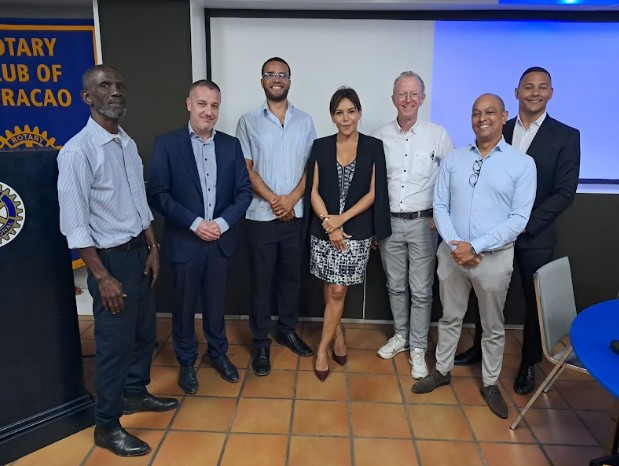
At a well-attended Economenclub meeting in Zeelandia, tax authority advisor Wim Nijdam opened the session by presenting research findings based on a survey of more than 1,100 companies. The results provided insight into the behavior and motivation of business taxpayers. Four out of five companies indicated that they are willing to pay taxes voluntarily. Nine out of ten support initiatives aimed at improving tax compliance. In principle, therefore, if all companies meet their tax obligations properly, most entrepreneurs would have little difficulty paying their own taxes.
However, this is where the problem arises. About half of the surveyed companies believe that the way tax assessments are imposed and collected is not fair. Improving this perception will require significant efforts, both in communication with taxpaying businesses and within the tax authority itself. That improvements are already underway is reflected in the strong increase in tax revenues, which rose by 31 percent between 2021 and 2024. During the same period, the share of companies submitting their tax returns on time increased from 70 percent in 2021 to 90 percent in 2024.
One internal improvement discussed during the meeting was the removal of so-called zero returns from the tax administration. These are filings by existing companies that have no turnover and no employees, yet are still required to submit monthly returns. Thousands of such filings are processed each month, placing a significant and arguably unnecessary burden on the tax administration.
The second part of the meeting focused on the economic outlook for Curaçao in 2026. Chris Rigaud of the Central Bank of Curaçao and Sint Maarten presented the latest projections. The economy is expected to grow by 2.4 percent in real terms, driven mainly by continued growth in tourism. Inflation is forecast to remain limited at around 2 percent. Foreign exchange reserves are projected to remain strong, covering 4.9 months of imports, well above the minimum benchmark of three months. Government finances are expected to show a surplus of 1.1 percent of gross domestic product.
Does this mean there is nothing to worry about? Not entirely. Ongoing tensions with Venezuela, uncertainty surrounding monetary policy, particularly in the United States, and the low level of public investment were identified as risks to the economy. According to the analysis, even if tourism were to decline by a total of 5 percent in 2026, Curaçao’s economy appears sufficiently robust to absorb the impact. For long-term, sustainable economic development, Rigaud argued that the government should develop and actually implement multi-year investment programs and take a serious look at the current social security system, which is widely seen as not future-proof. Greater cooperation between Curaçao and other Caribbean islands was also highlighted as part of the solution.
The discussion also brought several sensitive issues to the surface. One concern is the rapid growth in the number of hotel rooms and apartments, which could increase by as much as 70 percent between 2025 and 2030. How Curaçao will manage this expansion remains an open question. Some participants pointed to the carrying capacity study that has reportedly been with the Council of Ministers for some time, suggesting that its findings could offer guidance, if and when they are made public and acted upon. Another issue is the distribution of economic growth. Income inequality on the island remains significant, and there is a widespread perception that much of the growth of recent years, including current growth and projected growth for 2026, has benefited a relatively small group rather than the broader population.
In short, the outlook is positive and 2026 is expected to be somewhat better, but economic risks and structural challenges persist.
The meeting concluded with an informal gathering of economists, during which further ideas were exchanged on how to improve Curaçao’s economic performance. In part for this reason, the Economenclub intends to continue organizing discussions on economic issues that are relevant to Curaçao and the other Caribbean islands within the Kingdom.
